How to Choose Mountain Bike Gearing That Actually Handles Steep Climbs
Quick Answer: A wider gear range with a smaller lowest gear (a bigger cassette cog paired with a smaller chainring) is what actually makes steep climbs manageable — swapping to a setup with a lower climbing gear, rather than just building more leg strength, is often the faster fix for riders who consistently struggle on steep trail sections.
Grinding to a stop halfway up a steep climb feels like a fitness failure, but on a lot of stock mountain bike builds, it’s actually a gearing mismatch for the terrain being ridden.
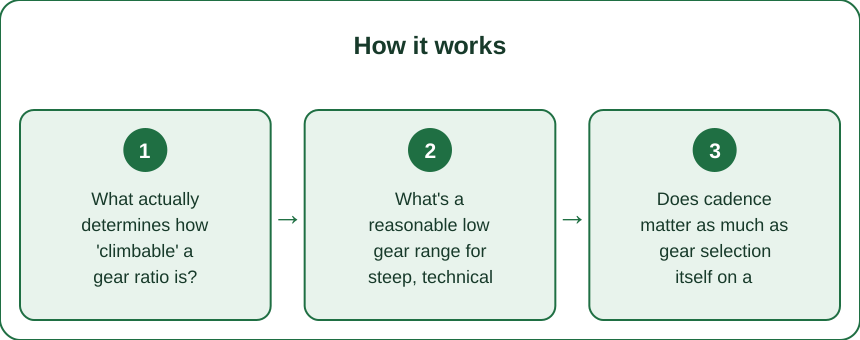
What actually determines how ‘climbable’ a gear ratio is?
Gear ratio comes down to the relationship between chainring size (front) and cassette cog size (rear) — a smaller chainring paired with a larger rear cog produces a lower, easier-to-pedal gear, which is what actually matters for steep climbing, more than overall bike weight or rider fitness in a lot of cases. Many stock mountain bikes, particularly those built with road or general trail riding in mind, ship with a gear range that doesn’t go quite low enough for genuinely steep, technical climbs.
A useful way to think about it: if you’re consistently unable to keep a steady cadence and have to stand and mash on climbs your riding partners handle seated, that’s a signal worth checking your actual lowest available gear ratio against theirs, rather than assuming it’s purely a fitness gap.
What’s a reasonable low gear range for steep, technical climbing?
Modern 1x (single chainring) drivetrains commonly pair a 30-32 tooth chainring with a cassette that extends to 50-52 teeth on the low end for trail and enduro-oriented setups, which produces a noticeably easier climbing gear than older or more road-oriented gearing. Riders on steeper, more technical local terrain often benefit from sizing down the chainring specifically (a 28-30t rather than 32-34t) even if it means a slightly less aggressive top-end gear for flat sections, since climbing capability is the more common limiting factor for a lot of trail riding.
Does cadence matter as much as gear selection itself on a climb?
Yes — even the right gear range doesn’t help much if cadence drops too low, since a very low cadence on a steep, technical climb makes it harder to maintain balance and traction over roots or loose terrain. A sustainable cadence in the 70-90rpm range, shifted down early before the climb gets steep rather than mid-climb under load, keeps both pedaling efficiency and bike control intact — shifting under heavy load is also a common cause of dropped chains on steep sections.
Myth vs Fact: Mountain Bike Climbing Gear Setup
Myth: Struggling on climbs is always a fitness issue that more training will fix. Fact: Gearing mismatch for local terrain is a common, underappreciated factor — a proper low gear can make a meaningful difference independent of fitness level.
Myth: A wider gear range always means sacrificing top-end speed on flats. Fact: Modern wide-range cassettes paired with a slightly smaller chainring often preserve reasonable top-end range while adding a genuinely lower climbing gear, without a dramatic tradeoff for most trail riding.
FAQ: Mountain Bike Climbing Gear, Answered
How do I know if my current chainring size is too big for local climbs?
If you’re regularly unable to hold a seated, steady cadence on climbs that others on similar bikes handle comfortably, or you’re forced to stand and mash frequently, checking your chainring size against a smaller trail-oriented option (often 2-4 teeth smaller) is a reasonable next step.
Is swapping a chainring a simple, affordable fix compared to a full drivetrain change?
Generally yes — swapping just the chainring is often the most cost-effective single change for improving climbing gear range, compared to replacing an entire cassette or drivetrain groupset.
Does tire choice affect climbing performance as much as gearing?
Tire tread and pressure affect traction on loose or technical climbing sections significantly, but gearing affects whether you can even maintain a sustainable pedaling effort in the first place — both matter, but they solve different parts of the climbing problem.
TL;DR:
- A smaller chainring paired with a wider-range cassette produces a genuinely lower climbing gear
- Stock gearing on many bikes doesn’t go low enough for steep, technical trail climbing
- Shift down early, before the climb gets steep, to maintain a sustainable 70-90rpm cadence
- A chainring swap is often the most cost-effective single climbing-gear upgrade
Before assuming a tough climb is purely a fitness gap, check whether your gearing actually gives you a low enough gear to work with.
Keep Reading
This article is for general informational and styling purposes only. Fit, sizing, and product availability may vary.