How Long Should You Break In New Mountain Bike Brake Pads?
Quick Answer: New pads need roughly 10-15 controlled hard stops from moderate speed to bed in properly — skip this and you’ll get squealing, uneven wear, and weaker braking for weeks instead of one afternoon.
You swap in fresh pads expecting instantly better braking, and instead you get a faint squeal and brakes that feel vaguely worse than the worn-out ones you just replaced. That’s not a bad pad — that’s a pad that hasn’t been bedded in yet.

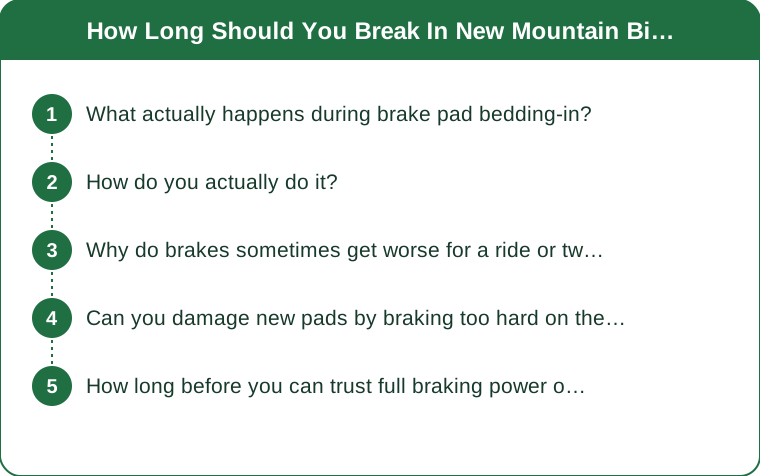
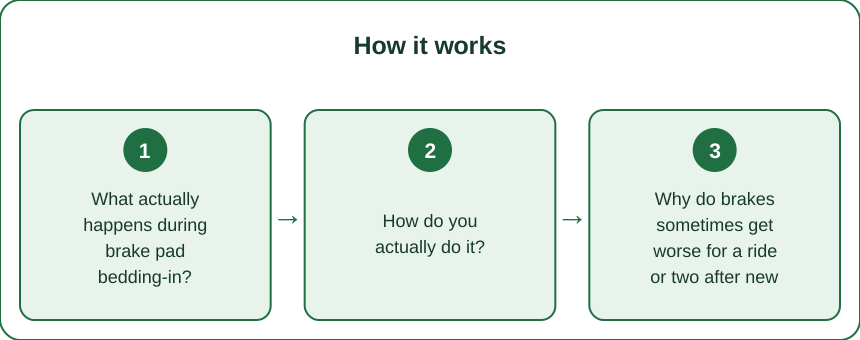
What actually happens during brake pad bedding-in?
New pad material and a new rotor surface haven’t transferred any material to each other yet — bedding-in is the process of laying down an even, thin film of pad compound onto the rotor. Until that film is even, your braking is inconsistent and noisy.
Skip it, and the pad wears unevenly from the start, which is why some riders swear a specific pad brand “never stops squealing” when really it was never bedded in correctly.
How do you actually do it?
Find a flat, open stretch and accelerate to about 15-20 mph, then brake firmly (not a full skid) down to a near-stop, and repeat 10-15 times without letting the brakes fully cool between stops. The heat buildup is intentional — that’s what transfers the pad material evenly.
Don’t come to a complete stop and hold the brake, and don’t do one giant panic stop — both leave an uneven, glazed deposit that causes exactly the squeal you’re trying to avoid.

Why do brakes sometimes get worse for a ride or two after new pads?
A slightly reduced bite for the first ride is normal — the rotor surface is being reconditioned along with the pad. It should improve noticeably by the end of the bedding-in sequence, not stay weak.
If it’s still weak or noisy after a proper bedding-in session, check that the pads are actually organic or metallic to match your rotor type — a mismatch will never fully bed in.
Can you damage new pads by braking too hard on the first ride?
Yes — one hard, sustained brake drag (like riding the brake down a long descent) before bedding-in glazes the pad surface with a hard, shiny layer that barely grips and is nearly impossible to fix without sanding the pad or replacing it.
This is the single most common reason a brand-new pad ends up performing worse than the old one it replaced.
How long before you can trust full braking power on new pads?
After the 10-15 stop sequence, give it one full ride before fully trusting technical descents — most riders notice full bite and zero noise by the second ride once bedding-in is done correctly.
TL;DR:
- Bedding-in is 10-15 firm (not full-lock) stops from 15-20 mph, back to back
- Skipping it causes squeal and uneven wear that can take weeks to self-correct
- Avoid one long hard brake drag before bedding-in — it glazes the pad
- Full power should return by your second ride post-bedding-in
Ten minutes in a parking lot before your next trail ride is the difference between brakes that bite clean all season and pads that squeal at every stop sign for the next month.
Keep Reading
This article is for general informational and styling purposes only. Fit, sizing, and product availability may vary.