How to Find Your Actual Saddle Height, and Why Most Riders Run It Too Low
Quick Answer: Set saddle height so your knee retains roughly 25 to 35 degrees of bend at the bottom of the pedal stroke, which for most riders is around 0.883 times inseam measured from the pedal spindle to the top of the saddle. A quick check: with your heel on the pedal at the bottom, your leg should be straight without your hips rocking. Most riders run low because they lowered it once for confidence on a descent and never put it back - a dropper post exists precisely so you do not have to compromise.
You climb slower than you should, your quads burn before your legs feel tired, and the front of your knee aches after long rides.
All three point at the same measurement, and it is the one nobody re-checks after the first month.
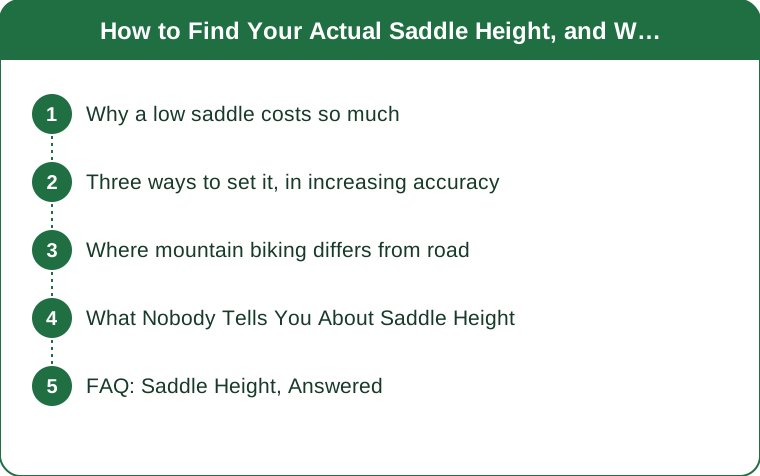
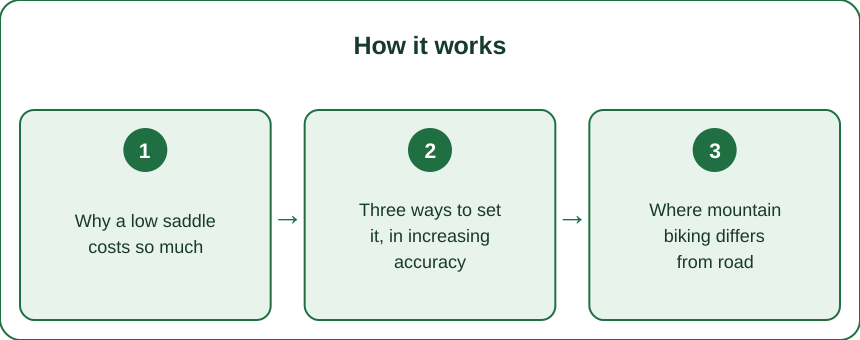
Why a low saddle costs so much
It shortens the effective leg extension, which means you produce force through a smaller range and lose power on every single pedal stroke. Over a long climb that compounds into a noticeable difference in both speed and fatigue.
It shifts the load onto the quads and away from the glutes and hamstrings, because a more closed hip angle reduces how much the posterior chain can contribute. That is why a low saddle produces quad burn well before general leg fatigue.
It increases compressive load at the front of the knee. A more acute knee angle at the top of the stroke raises patellofemoral pressure, which is one of the more common bike-fit-related complaints and among the easier ones to resolve.
It also raises your cadence requirement for the same speed, which makes steady climbing feel harder and less efficient than it should.
And it usually happened by accident. People drop the saddle for one technical descent, ride the rest of the day like that, and the position becomes normal - which is precisely what a dropper post was invented to prevent.
Three ways to set it, in increasing accuracy
The heel method, as a starting point. Sit on the bike, put your heel on the pedal at the bottom of the stroke with the crank in line with the seat tube. Your leg should be straight with your hips level. If you have to tilt to reach, it is too high; if there is bend, it is too low. Rough, quick, and better than guessing.
The inseam formula, for a real number. Measure your inseam by standing with your back to a wall, a book pulled up firmly between your legs, and measuring from the top of the book to the floor. Multiply by 0.883, and set that distance from the center of the pedal spindle to the top of the saddle with the crank at the bottom. This produces a very good starting position for most riders.
The knee angle method, for the most accurate result. Have someone film you pedaling from the side, and check that your knee retains 25 to 35 degrees of bend at the bottom of the stroke. Free phone apps measure the angle from a still frame adequately.
Then adjust in 5mm increments and ride each one for a full session, which is the part people skip. The body adapts to a position over a couple of rides, and judging a change from a five-minute test is unreliable.
Mark the post with tape or a marker at your climbing height, so the dropper always returns to the same place.

Where mountain biking differs from road
Many mountain bikers run 5 to 10mm lower than a pure road fit, to allow more body movement over the bike on technical terrain. That is a legitimate deliberate compromise; running an inch low is not.
The dropper post exists to remove the compromise entirely. Climb at your correct height, drop for descents, and stop splitting the difference. If you are not using the full drop, the post is not doing its job.
Steep climbing changes the effective angle, since the terrain pitches you backward relative to the bike. Some riders prefer a fractionally forward saddle position for sustained steep climbing, though this is a fore-aft adjustment rather than a height one.
Suspension sag affects real saddle height under load, which is why setting your sag correctly should come before fine-tuning height. A bike sitting 30 percent into its travel is effectively lower than it measures in the stand.
And shoe and pedal choice shift it. Changing from flat pedals to clipless, or between shoes with different stack heights, alters effective height by several millimeters - enough to matter if you were already dialed in.
What Nobody Tells You About Saddle Height
Too high causes worse problems than too low. Hip rocking, saddle sores, back-of-knee pain, and reduced control are what excessive height produces, and the pain arrives later and is harder to attribute. Err low if you are unsure and creep upward.
Five millimeters is a noticeable change. People expect to need centimeters and are then surprised that a 5mm adjustment changes how a climb feels. Adjust in small increments.
Saddle tilt and fore-aft interact with height, so changing one usually means rechecking the others. A nose-up saddle in particular changes effective reach and pressure distribution significantly.
Flexibility limits how high you can usefully go. Restricted hamstrings cause the pelvis to rock at heights that would otherwise be correct, and the fix there is mobility work rather than forcing the position.
Persistent knee pain deserves a professional bike fit or a medical opinion rather than repeated home adjustment. Front-of-knee pain often relates to a low saddle and back-of-knee to a high one, but pain that does not resolve with a sensible adjustment is not a fit problem to solve alone. This is general information, not medical advice.
And re-check it seasonally. Shoes change, cleats wear, posts slip, and fitness changes what feels comfortable - a five-minute check twice a year catches all of it.
FAQ: Saddle Height, Answered
What is the fastest reasonable check?
Heel on the pedal at the bottom of the stroke: leg straight, hips level. It gets you close in thirty seconds.
How much lower should a mountain bike be than a road bike?
Commonly 5 to 10mm for control on technical terrain. More than that is usually accidental rather than deliberate.
Front of the knee hurts - too high or too low?
Usually too low, which increases patellofemoral compression. Back-of-knee pain more often points to too high.
Does the dropper post change the number?
No - set your climbing height correctly and use the drop for descents. Mark the post so it returns to the same place.
How long should I test a change?
A full ride, and ideally two. Five minutes in a car park tells you very little.
Do I need a professional fit?
Not for a starting position, which you can set well yourself. Worth it if you have persistent pain or ride long distances regularly.
TL;DR:
- Aim for 25 to 35 degrees of knee bend at the bottom of the stroke, or roughly 0.883 times inseam from pedal spindle to saddle top.
- A low saddle shifts load to the quads, reduces power, and increases front-of-knee compression.
- Adjust in 5mm increments and test each change over a full ride, not a car park lap.
- Mountain bikers reasonably run 5 to 10mm lower than road fit; an inch low is accidental, not a choice.
- Set suspension sag first, mark your climbing height on the post, and re-check seasonally as shoes and cleats change.
Persistent knee pain is not a fit problem to solve by trial and error - get a professional fit or a medical opinion.
Keep Reading
This article is for general informational and styling purposes only. Fit, sizing, and product availability may vary.