Why Wet Leaves Are More Slippery Than Mud — and How to Ride Them
Quick Answer: Wet leaves are worse than mud because they form a low-friction layer that slides against itself and against the ground beneath it. Mud, at least, deforms and lets knobs dig in. A leaf mat gives your tread nothing to bite — the leaves shear away as a sheet. They also hide roots, rocks and the trail edge entirely. The response is lower pressure, earlier braking, weight further back on descents and a much wider line through corners.
The first proper leaf drop arrives and a trail you have ridden three hundred times behaves like a completely different trail.
Riders who are fine in deep winter mud get caught out in October.
There is a good reason, and it is not confidence.

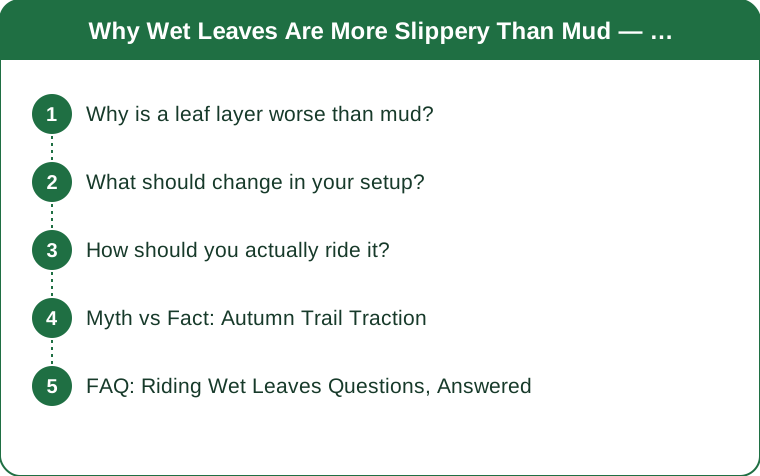
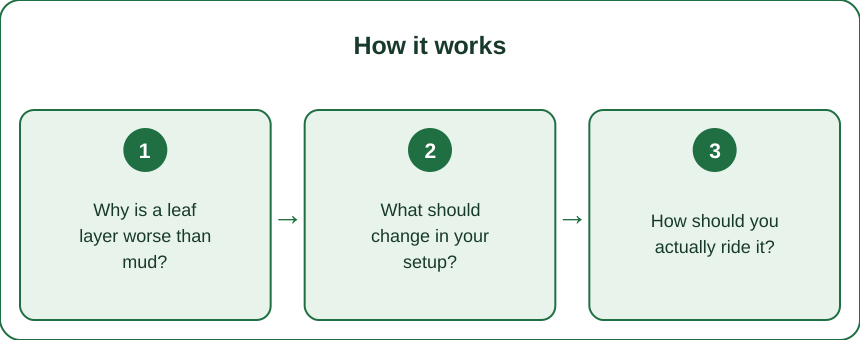
Why is a leaf layer worse than mud?
Because your tyre never reaches the ground, and the layer itself has almost no shear strength.
Knobs need something to displace. In mud, the tread cuts through the surface and finds material to push against. A wet leaf mat compresses and then slides as an intact sheet, so the knobs never engage anything.
Wet leaves are slippery against each other, not just against the ground. The layer shears internally. Even if the leaves grip the soil, the leaf-on-leaf interface fails first.
They hide everything. Roots, edges, rock, ruts and hole. Riding leaves is riding partly blind, and the surprises arrive at the moment you have least traction.
They hold water long after the rain stops. A leaf layer keeps the soil beneath it damp for days, so a trail can look dry in the sun and be greasy underneath.
They pack into the tread. A tread full of leaf matter is effectively a slick. This happens faster on tighter-spaced treads and is one reason mud-specific tyres do comparatively well in leaves.
And the trail underneath has changed too. Autumn soil is wetter than summer soil, so you are dealing with reduced base traction and a low-friction cover simultaneously.
What should change in your setup?
Pressure, tyre choice and brake setup, in that order of impact per minute spent.
Drop pressure, but less than you would for mud. A few PSI helps the casing conform. Going very low does not help here, because the problem is the interface above the ground, not ground compliance. Small reductions from summer pressure are usually the right move.
Wider-spaced knobs clear leaf matter far better. A mud or intermediate tread with generous spacing sheds leaf debris; a fast-rolling tightly-spaced tread packs and turns into a slick.
Tall side knobs matter more than centre tread. Leaf corners fail at the edge of the tyre, so cornering knob height and support is the spec that actually saves you.
Check brake pad condition before the season. Autumn grit and wet leaf debris are abrasive, and pad wear accelerates markedly. Starting the season on half-worn pads means running out at the worst point.
Consider softer compound tyres for the season. Slower rolling, meaningfully more grip in the cold. Autumn and winter is the time of year that trade makes sense.
Fit or check mudguards. Not for style — a front guard keeps leaf slurry off your face and out of your eyes, and vision is a real traction input.
Seasonal note: suspension damping behaves differently in cold weather too, since oil viscosity rises. If your fork feels harsh in October at the same settings that were perfect in August, back the compression damping off a few clicks rather than assuming something has failed.

How should you actually ride it?
Everything earlier, everything smoother, everything wider.
Brake earlier and in a straight line. Braking traction and cornering traction come from the same limited budget. On leaves the budget is small, so spend it on one thing at a time.
Use the rear brake more than usual on descents. A front wheel that washes on leaves gives you almost no warning. The rear stepping out is recoverable; the front is often not.
Widen your line and reduce lean angle. A wider, straighter arc through a corner requires less lateral grip. Slower entry and a straighter exit is faster overall on a greasy trail.
Stay centred and light, and get behind the saddle earlier on steeps. Weight too far forward on a leafy descent is the classic front-wash setup.
Look further ahead than you think you need to. With obstacles hidden, you need more reaction distance, and looking further ahead buys it.
Ride roots at as close to 90 degrees as possible. A wet root crossed at an angle under a leaf layer is the single most common autumn crash. If you cannot see them, assume they are there wherever the trail dips.
Keep your speed steady rather than accelerating and braking. Traction is lost by changes in demand. Smooth inputs on a low-grip surface are worth more than good technique with abrupt inputs.
Accept a slower ride for two months. Autumn is skills season. Riders who accept 15 percent slower and stay upright come out of winter better than those who ride the same times and crash twice.
Myth vs Fact: Autumn Trail Traction
Myth: If you can ride mud, you can ride leaves. Fact: Different mechanism. Mud deforms and lets knobs engage; a leaf mat shears as a sheet and gives them nothing.
Myth: Very low pressure is the answer. Fact: Low pressure helps ground conformity, and your tyre is not touching the ground. Modest reductions plus tread spacing does more.
Myth: Dry-looking leaves are safe. Fact: A leaf layer holds moisture underneath for days. Surface dryness tells you very little about the interface.
Myth: More front brake gives more control on descents. Fact: On leaves the front washing out is the main crash mode. Bias slightly rearward and brake earlier instead.
Myth: Leaves are only a problem in corners. Fact: They are worst in corners and on off-camber sections, but the hidden-obstacle problem applies everywhere.
Myth: Semi-slick rear tyres are fine in autumn. Fact: They pack with leaf matter almost immediately and become genuinely slick. This is the wrong season for a fast-rolling rear.
FAQ: Riding Wet Leaves Questions, Answered
What tyre pressure should I run in leaves?
A few PSI below your summer setting, not a dramatic drop. Tread spacing and compound matter more than pressure here.
Should I change tyres for autumn?
If your current tyres are tightly spaced or hard compound, yes — it is the single biggest improvement available.
How do I avoid the front washing out?
Brake in a straight line before the corner, reduce lean angle, widen the line, and keep weight centred to slightly rearward.
Are hidden roots really that dangerous?
They are the most common autumn crash cause. Cross them as close to perpendicular as you can and assume they exist in every dip.
Do brake pads wear faster in autumn?
Markedly — wet grit is abrasive. Check them at the start of the season and carry a spare set.
Should I just ride somewhere else until winter?
Rock and gravel trails are far less affected. Rotating toward them for the peak leaf weeks is a legitimate choice rather than an admission of anything.
TL;DR:
- Wet leaves shear as a sheet, so knobs never reach the ground — worse than mud, which at least deforms.
- They also hide roots, rocks and edges and keep the soil beneath damp for days.
- Setup: wider-spaced tread, softer compound, tall side knobs, a few PSI lower, fresh brake pads.
- Riding: brake earlier and straight, bias slightly rearward, widen the line, cross roots at 90 degrees.
- Back off compression damping in the cold — fork oil thickens and the ride goes harsh.
Accept 15 percent slower for two months. It is the cheapest crash prevention there is.
Keep Reading
This article is for general informational and styling purposes only. Fit, sizing, and product availability may vary.