Why Your Dropper Post Feels Slow to Return (and the 2-Minute Fix)
Quick Answer: A slow-returning dropper post is usually low internal air pressure (needs a shock pump top-up) or excess cable friction, not a failed post. Both are fixable trailside or at home in under ten minutes.
That half-second lag between releasing the lever and the post actually rising doesn’t mean your dropper is dying. It’s almost always one of two boring, fixable causes.

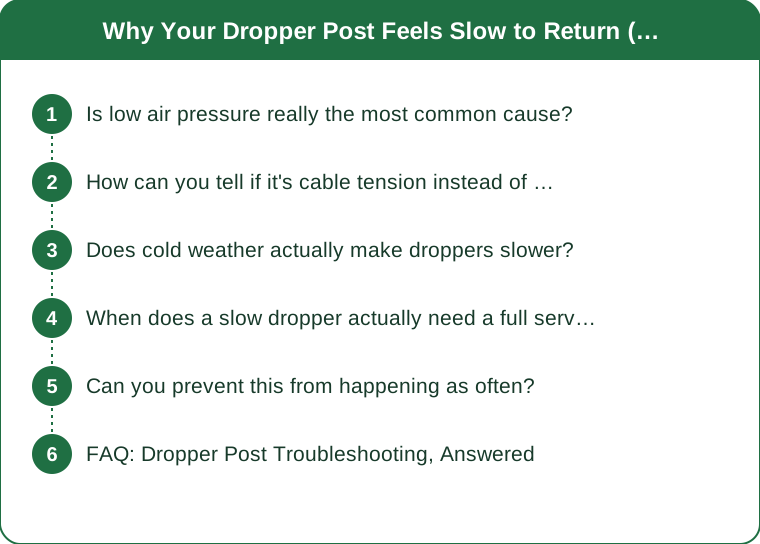
Is low air pressure really the most common cause?
Yes — droppers rely on internal air pressure to push the post back up, and pressure naturally bleeds down over months of use. A post that returns slowly but eventually reaches full extension, with no unusual noise, points strongly at needing a top-up through the post’s air valve, typically to the manufacturer’s spec (often 250-300 psi depending on model).
How can you tell if it’s cable tension instead of air pressure?
If the post is slow or sticky only at certain points in the stroke, not uniformly, cable friction or a kinked housing is more likely than a pressure issue. Detaching the cable at the lever and manually checking if the post moves freely by hand isolates whether the actuation mechanism or the air spring is the culprit.
Does cold weather actually make droppers slower?
It can — the internal seals and air spring both stiffen slightly in cold temperatures, which can mimic a low-pressure symptom on cold mornings that disappears once the post warms up during the ride. If the slowness only shows up on the first descent of a cold day, this is likely the explanation rather than an actual mechanical fault.

When does a slow dropper actually need a full service instead of a quick fix?
If air top-up and cable adjustment don’t resolve it, or if you hear grinding or feel binding at a specific point every time, worn internal seals or bushings are the more likely cause, and that requires a full service (either a shop rebuild or a manufacturer service kit) rather than a trailside fix.
Can you prevent this from happening as often?
Keeping the post clean of trail grit, especially around the seal at the top of the lower tube, and doing a seasonal air pressure check are the two most effective preventive habits — most dropper issues trace back to either contamination working past the seals or pressure gradually declining unnoticed over months.
FAQ: Dropper Post Troubleshooting, Answered
Can you over-inflate a dropper post’s air chamber?
Yes — exceeding the manufacturer’s max psi can damage seals, so always check your specific post’s spec sheet rather than guessing a number.
Is it normal for a dropper to feel different right after a service?
A freshly serviced post often feels faster and firmer initially before settling into its normal feel over a few rides as seals seat in.
Should you carry a shock pump on rides specifically for the dropper?
Many riders do keep a small pump in their pack, since a pressure top-up is one of the few dropper issues fixable mid-ride without tools beyond the pump itself.
TL;DR:
- Slow dropper return is usually low air pressure or cable friction, not a failing unit
- Uniform slowness points to pressure; slowness at one specific point points to cable or contamination
- Cold mornings can temporarily mimic a low-pressure symptom
- Grinding or binding that persists after a top-up means it’s time for a full seal service
Check the air pressure first — it solves the majority of dropper complaints and takes less time than diagnosing anything more complicated.
Keep Reading
This article is for general informational and styling purposes only. Fit, sizing, and product availability may vary.