Why Your Rear Brake Fades on Long Descents and What Actually Prevents It
Quick Answer: Rear brake fade on long descents happens when heat builds up faster than the rotor and caliper can shed it. In hydraulic disc brakes the usual failure is fluid or pad related: overheated fluid, especially DOT fluid that has absorbed water, forms vapour bubbles that compress, so the lever travels further; overheated pads glaze or outgas and lose friction. The rear brake overheats first because riders drag it. The fix is intermittent hard braking rather than continuous light dragging, plus a larger rotor.
You are three minutes into a long descent, the rear lever starts feeling vague, and by the bottom it is coming most of the way to the bar with half the stopping power.
This is thermal, and it is almost entirely a consequence of how the rear brake gets used rather than of the brake being inadequate.
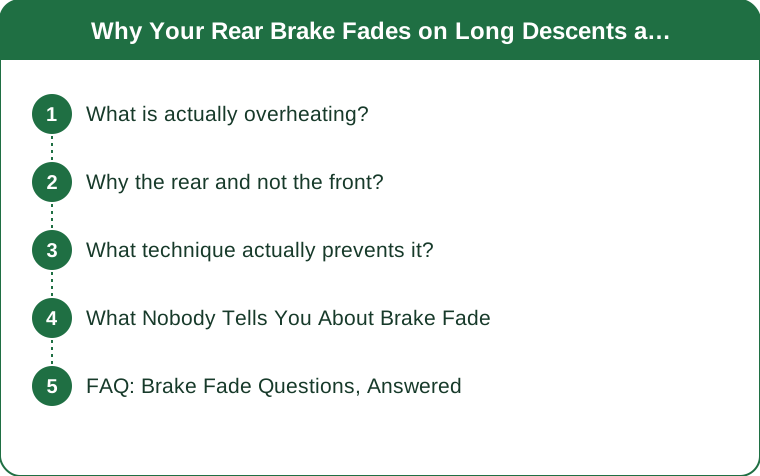
What is actually overheating?
Three candidates, and the symptom tells you which one you have.
1. Brake fluid, producing a spongy lever with increased travel. This is the classic fade and the most common on long descents.
- DOT fluid is hygroscopic, meaning it absorbs water from the air over time. Water lowers the boiling point substantially: fresh DOT 5.1 boils around 270C, and the wet boiling point after a year or two of service can be under 190C. When the fluid near the caliper boils, vapour bubbles form, and vapour compresses where liquid does not, so lever travel increases.
- Mineral oil, used by some manufacturers, is not hygroscopic, so its boiling point does not degrade with age. It generally has a lower initial boiling point but does not deteriorate the same way.
2. Pad material, producing a hard lever with poor power. This is the diagnostic distinction that matters. If the lever feels normal or firm and the bike simply does not slow down, the pads have glazed or are outgassing rather than the fluid boiling. Organic and resin pads fade at lower temperatures than sintered metallic pads.
3. Piston seals and fluid expansion, producing rub or a rising bite point. As everything expands with heat, the pistons can advance, causing the pads to contact the rotor continuously, which generates more heat. This is a self-reinforcing loop and it is why fade often accelerates rather than developing gradually.
The diagnostic in one line: soft, long lever means fluid. Firm lever with no power means pads. Rub that appears mid-descent and disappears when cool means expansion.
Rotors can reach 300 to 500C on a sustained descent, which is enough to discolour them permanently. Blue or straw-coloured patches on a rotor are a record of how hot it has been.
Why the rear and not the front?
Because of how most riders use it, and physics makes the rear worse at handling heat.
Riders drag the rear. The rear brake feels safer, so it gets held lightly and continuously through a descent while the front is used in short applications. Continuous light braking is the worst possible thermal input: it puts energy in constantly with no opportunity for the rotor to shed it between applications.
The rear does less work and generates heat less efficiently. Under braking, weight transfers forward. The rear wheel has less traction, so it can only absorb a limited amount of braking force before it skids. The energy it does absorb goes into a rotor that is often smaller, and it is being applied constantly rather than in bursts.
Rear rotors are frequently smaller. A common setup is 180mm front and 160mm rear. A smaller rotor has less mass to absorb heat and less surface area to shed it, and it operates at a smaller radius so it needs more clamping force for the same braking torque.
Airflow at the rear is worse. The rear caliper sits in more turbulent, partly shielded air behind the frame and rider, so convective cooling is less effective.
The compounding effect. All four of these push the same direction. The rear brake receives constant energy input, has less thermal mass, worse cooling, and is doing work inefficiently. It is unsurprising that it fades first.
Rider weight and terrain matter too. Braking energy is proportional to mass and to vertical drop. A heavier rider on a longer descent puts substantially more energy into the brakes, which is a reason the same setup works for one rider and not another.

What technique actually prevents it?
Braking harder and less often, which is counterintuitive and is the whole answer.
Why intermittent braking works. Heat generation is roughly the same for a given descent, since you are dissipating the same potential energy either way. What changes is the peak temperature and the cooling opportunity. Short, firm applications followed by full release let the rotor shed heat between applications. Continuous dragging never gives it a chance.
The practical method:
- Brake hard into the corner, release completely through it. This is the standard technique for other reasons, notably traction, and its thermal benefit is significant.
- Pick a target speed and control to it in bursts rather than holding a constant light pressure.
- Fully release. Half-releasing leaves the pads in contact and defeats the purpose. The lever should return all the way.
Use the front brake more. Most riders under-use the front, which does the majority of effective braking anyway. Shifting braking effort forward reduces rear input and uses the larger, better-cooled rotor.
Equipment changes that help, in order:
- A larger rear rotor. Going from 160mm to 180mm adds thermal mass and leverage. The single most effective hardware change.
- Sintered metallic pads. Higher fade resistance at temperature. They are noisier and wear rotors faster, which is an acceptable trade on descents.
- Fresh fluid, annually if DOT. Absorbed water is the main reason fade appears on a brake that used to be fine. This is a maintenance issue disguised as an equipment issue.
- Finned pads and heat-dissipating rotors, which help measurably and less than the above.
What to do if it happens mid-descent: stop for two minutes. Do not pour water on a hot rotor, which can warp it. Let it cool in air, and reassess whether you should be riding the rest of the descent on a compromised brake.
What Nobody Tells You About Brake Fade
A recently bled brake with old fluid still fades. Bleeding removes air, and if you re-use contaminated fluid or only replace the small amount in the lines, the water content remains. Full fluid replacement is a different job from a bleed.
Fade is more likely on the second run than the first. The brakes have not fully cooled, so the second descent starts from a higher baseline. This is why the crash happens on lap two, and it is a good reason to take a proper break rather than a quick one.
Bedding in pads properly raises fade resistance. New pads need a bedding procedure, typically 20 to 30 progressive stops from moderate speed, which transfers an even layer of pad material to the rotor. Poorly bedded pads have uneven transfer, produce hot spots, and glaze earlier.
Contaminated pads mimic fade and are permanent. Any oil, chain lube, or degreaser on a pad ruins it. If your brake has poor power from the very first application rather than developing it, that is contamination, not heat, and the pads need replacing rather than cooling.
Rotor discolouration is diagnostic. Even blue across the whole braking surface means sustained high temperature. Localised blue patches suggest uneven contact or a warped rotor concentrating heat.
Riding position affects rear brake use more than people realise. A rider whose weight is too far forward feels unstable, and the reflex is to drag the rear for reassurance. Getting your hips back behind the saddle on steep sections reduces the psychological need to drag, which reduces heat.
Modulation is not the same as dragging. Good modulation means precise control of braking force. Dragging means holding a constant light pressure. Skilled riders modulate hard and release completely, and that combination is both faster and cooler.
Seasonal note: autumn descents are wetter, and wet rotors run cooler because water carries heat away, which masks fade until the first dry day. Riders who were fine all autumn and experience fade on a dry cold morning have usually not changed anything except the surface conditions.
This is general information about equipment behaviour, not a substitute for having your brakes serviced by a qualified mechanic. A brake that fades is a safety issue and warrants inspection.
FAQ: Brake Fade Questions, Answered
Why does my rear brake go soft on long descents?
Heat is building up faster than the rotor can shed it. A soft, long lever usually means the fluid is boiling and forming compressible vapour, which is more likely with older DOT fluid that has absorbed water.
Does dragging the rear brake cause fade?
Yes, it is the main cause. Continuous light braking puts energy in constantly with no cooling opportunity. Short firm applications with full release produce lower peak temperatures for the same descent.
Will a bigger rotor fix brake fade?
It helps substantially. A larger rotor has more thermal mass, more cooling surface, and more leverage. Going from 160mm to 180mm at the rear is the most effective single hardware change for a fading rear brake.
TL;DR:
- A soft, long lever means boiling fluid. A firm lever with no power means glazed or outgassing pads.
- The rear fades first because riders drag it, and it has less thermal mass and worse airflow than the front.
- Brake hard in short applications and release fully. Same energy dissipated, far lower peak temperature.
- Replace DOT fluid annually. Absorbed water can drop the boiling point below 190C.
On your next descent, count your brake applications instead of holding the lever. Most riders are surprised how much they drag.
Keep Reading
This article is for general informational and styling purposes only. Fit, sizing, and product availability may vary.