Your Suspension Really Does Feel Different in Late Summer
Quick Answer: Air spring pressure rises roughly 2 percent for every 10F increase in temperature. A fork set to 80 psi in a 60F garage reads about 84-85 psi on a 100F trail. Add heated damper oil thinning out, and the same setup genuinely rides differently in August than it did in April.
Nothing on your bike changed and the fork feels harsh over small chatter while blowing through the mid-stroke. You are not imagining it, and it is not time for a service.
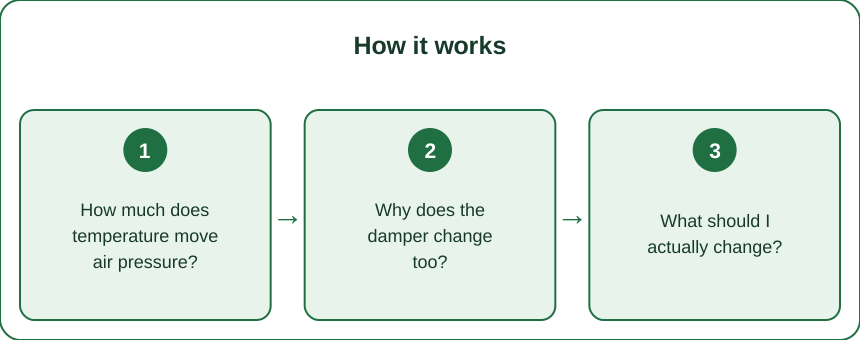
How much does temperature move air pressure?
Gay-Lussac’s law: at constant volume, pressure scales with absolute temperature. In practical terms for suspension, that is about 2 percent per 10F.
Set 80 psi at 60F, ride at 100F, and you are effectively running 83-84 psi. On a fork that likes a 3-5 psi window, that is a meaningful shift.
The rear shock is worse, because shock pressures are higher. A 200 psi shock set in a cool garage runs 208-210 psi on a hot day, which is enough to noticeably reduce sag and raise the ride height.
Why does the damper change too?
Damper oil viscosity drops as it heats. Thinner oil moves through shim stacks and ports more easily, which means less damping force for the same shaft speed.
So you get a stiffer spring and a softer damper simultaneously. That combination produces exactly the complaint people describe: harsh on small bumps, because the higher spring pressure resists initial movement, and wallowy or divey in the mid-stroke, because compression damping fell off.
On a long descent the effect compounds. Repeated cycling heats the oil further, so the last third of a descent damps differently than the first.
What should I actually change?
Set pressure at trail temperature, not garage temperature.
- Roll out, ride five easy minutes, then check pressure at the trailhead in the sun
- Expect to drop 3-5 psi in the fork and 6-10 psi in the shock versus your cool-garage number
- Add a click or two of low-speed compression to compensate for the thinner oil
- Re-check sag once the bike has been in the heat for 20 minutes, not the moment you park
Then write down both numbers, hot and cold. Having a summer setting and a spring setting is normal, and it takes one ride to establish.
5 Mistakes Riders Make Chasing This
1. Adjusting pressure in an air-conditioned garage. The number is right for the garage and wrong for the trail.
2. Checking pressure with a shock pump repeatedly. Every connection bleeds a small amount of air, so five checks in a row genuinely lowers your pressure. Check once.
3. Blaming the tune. Riders send forks for service in August that were perfectly fine in June. Test temperature-adjusted settings first.
4. Ignoring tire pressure. Tires shift with the same physics and at lower absolute pressures the percentage effect on feel is larger. A 22 psi tire becomes 23 psi, which changes grip noticeably.
5. Assuming the effect reverses instantly. Air pressure equalizes fast, but damper oil takes 15-20 minutes to cool. A shuttle lap starting on a hot damper feels different from the first lap of the day, and this catches even experienced riders.
FAQ: Suspension and Temperature, Answered
Does this affect coil shocks?
Coil springs are essentially temperature-stable, which is one of their real advantages. The damper still changes, so a coil bike shifts less but not zero.
How much sag change should I expect?
Typically 2-4 percent of travel between a cool morning and a hot afternoon. Enough to feel, not enough to be alarming.
Should I run different settings for a bike park day?
Yes. Continuous descending heats dampers far more than trail riding, and many riders add low-speed compression for park days for exactly this reason.
TL;DR:
- Air pressure rises about 2 percent per 10F, so hot trails effectively add 4-5 psi
- Damper oil thins with heat, cutting compression damping at the same time
- Set pressure at the trailhead, not in the garage, and log a hot and a cold number
- Tires shift by the same physics and matter more than most riders expect
Next ride, bring the shock pump and set your pressures after five minutes of pedaling in the sun. One session of doing this gives you a summer baseline you will reuse every year.
Keep Reading
This article is for general informational and styling purposes only. Fit, sizing, and product availability may vary.